What Is an SMS Gateway? How It Works & Why Businesses Use It
An SMS gateway connects your app to carrier networks so you can send SMS automatically and at scale. Here's how it works and why businesses rely on it.
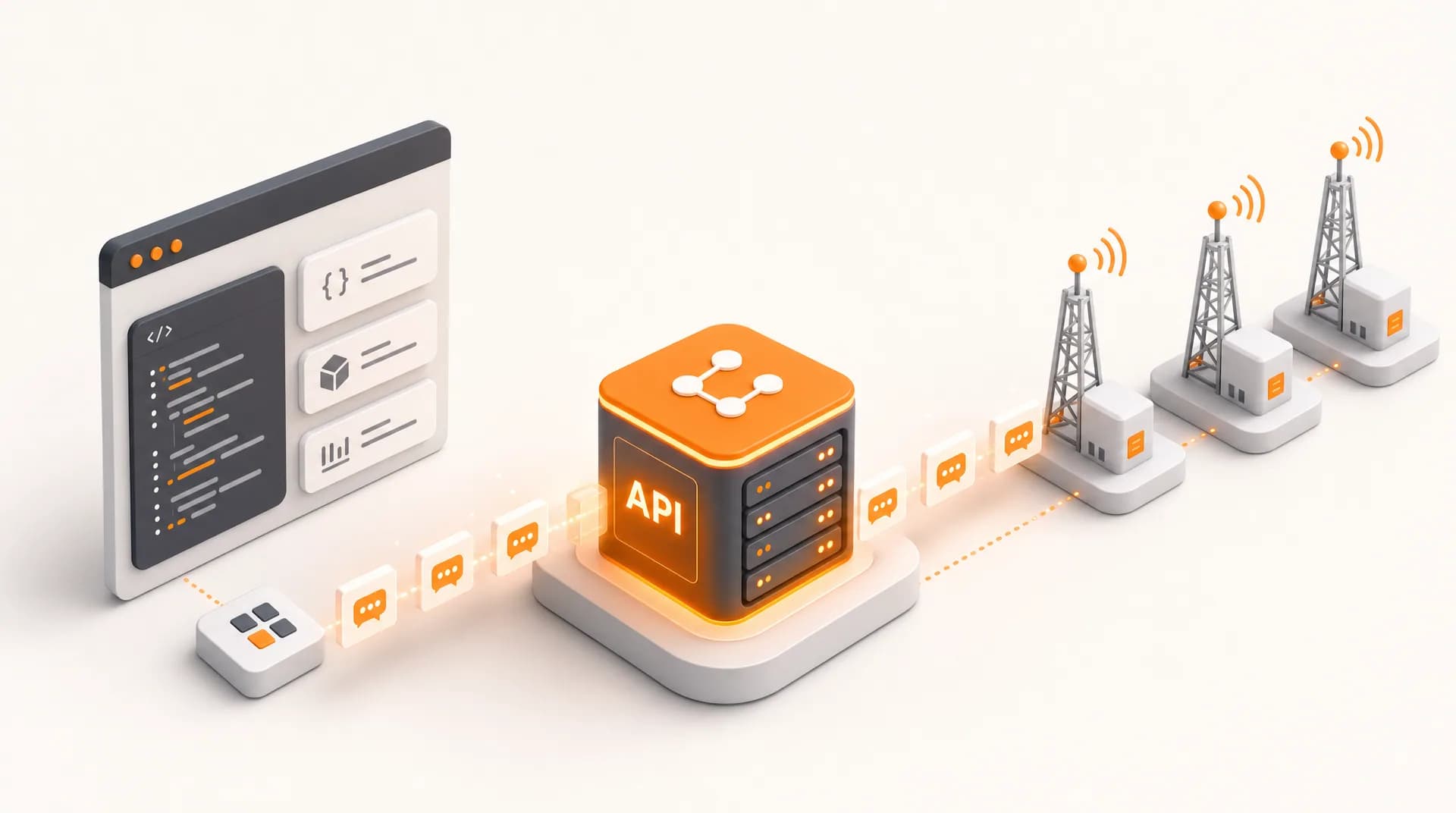
Sending one SMS from your phone is easy. Sending 50,000 OTP or notification messages straight from your app, automatically and with a delivery status you can track, is an infrastructure problem. An SMS gateway is that infrastructure: the layer that connects your application to the carrier networks through an API.
What is an SMS gateway?
Technically, an SMS gateway bridges your application to the carrier's Short Message Service Center (SMSC), the network component that actually delivers SMS to recipients' phones. Your app just sends a request over an HTTP API; the gateway translates it into the carrier protocol (SMPP) and forwards it to the SMSC. The message lands in seconds, and you never touch a SIM card or a modem.
Types of SMS gateway
The term "SMS gateway" covers several forms, from hardware to cloud services:
- Hardware (GSM) gateway. A device with a GSM modem and SIM card that sends SMS straight over the cellular signal, installed on your own network. Fine for low volume, but limited and hard to scale.
- Direct-to-SMSC. An application connects straight to a carrier's SMSC over the SMPP protocol, usually via the internet or a dedicated leased line. This is the route aggregators and large enterprises use.
- Cloud (HTTP API) gateway. A provider manages the carrier connections and you simply call their HTTP API. Fastest to integrate and easiest to scale, this is the model Zenziva uses.
How an SMS gateway works
For a cloud gateway, the model most businesses use, the flow looks like this:
- Your app sends a request to the gateway API (destination number + message).
- The gateway picks the best route and forwards the message to the destination carrier's SMSC (sometimes via an intermediary aggregator).
- The SMSC delivers the SMS to the recipient's phone.
- The delivery status (sent/failed) is returned to your system via callback or report.
Why businesses need an SMS gateway
- Automated. Messages are triggered by your system, OTP at login, notifications on transactions, reminders at due dates.
- Scale. Send thousands to millions of messages with no manual effort.
- Reach. SMS lands on any phone, with no internet needed on the recipient's side.
- Trackable. Every message has a delivery status for audit and analytics.
- Integrated. Plugs directly into your app, website, or ERP/CRM via API.
SMS gateway vs sending manually
| Manual sending | SMS gateway | |
|---|---|---|
| Volume | Limited, one by one | Thousands–millions, automated |
| Trigger | A human | Your system (real-time) |
| Sender identity | A personal number | Brand name (Sender ID) |
| Reporting | None | Per-message status & analytics |
Features to look for
- A clear, documented API for fast integration.
- Sender ID / SMS Masking so messages show your brand name.
- Delivery reports and status callbacks.
- A dedicated OTP route for time-sensitive verification messages.
- Local technical support that understands Indonesian carrier rules.
An SMS gateway with Zenziva
Zenziva provides an SMS gateway with a lean HTTP API, plus SMS Masking for a brand-name Sender ID, delivery reports, and a dedicated OTP route. You just call the endpoint from your app, website, or system. Code samples are in the docs, and you can estimate the cost on the pricing page.
- An SMS gateway connects your system to carriers via an API.
- Ideal for OTP, notifications, and reminders at scale and automated.
- Look for a clear API, Sender ID, delivery reports, and an OTP route.
Ready to send SMS straight from your code? Open the API docs, or sign up and start using the Zenziva SMS gateway today.
Reach Customers on Their Favorite Channels
Need WhatsApp, SMS, or Voice Calls? Choose the communication channel that best fits your business needs today.