WhatsApp Business API (WABA) Economics: Message Categories & Cost Control
WhatsApp Business API (WABA) is billed per message by category, not per conversation. Here's how the categories work, what changes on 1 October 2026, and how to keep bills steady.
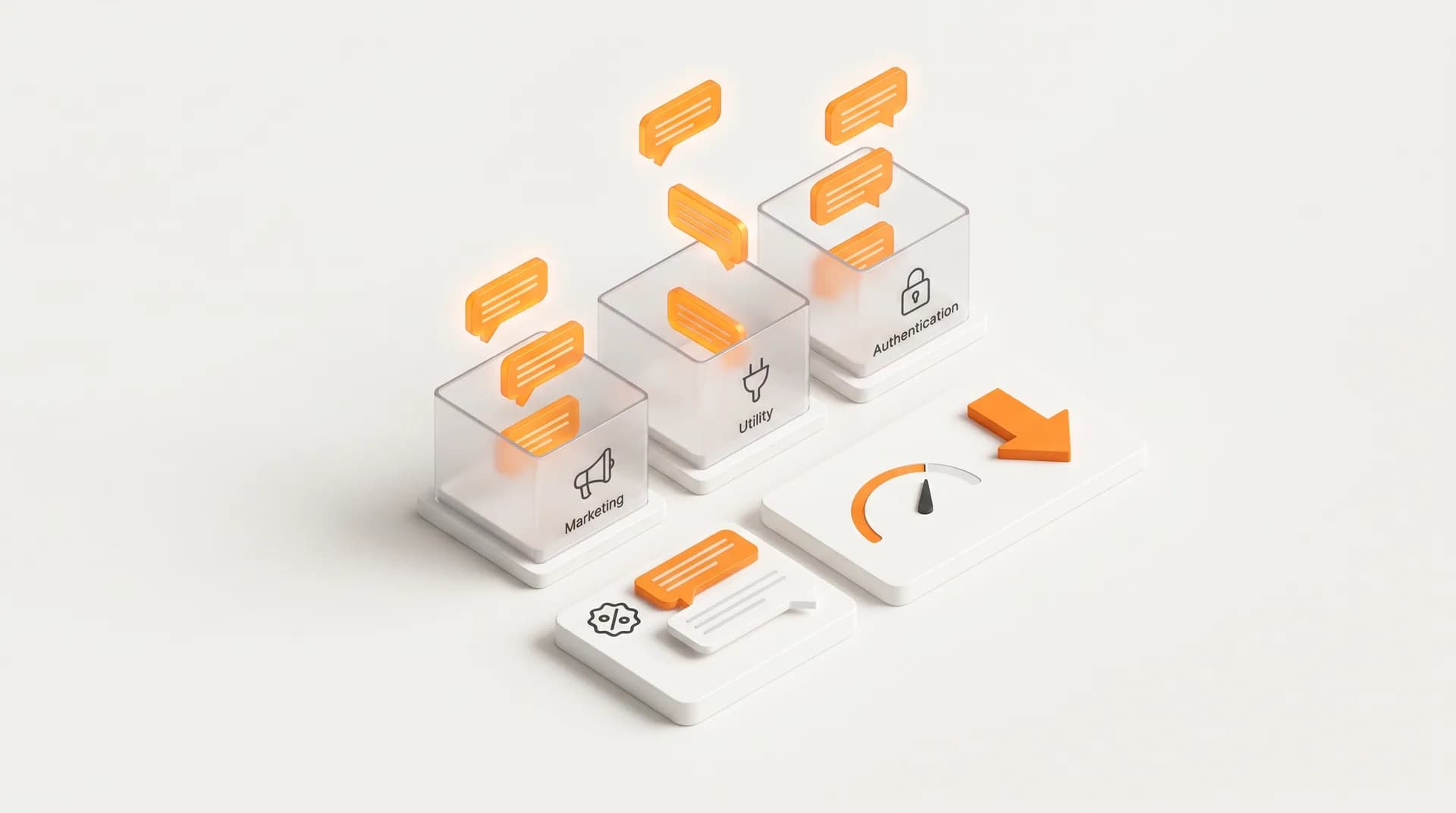
WABA isn't billed like a phone bill or a flat session fee, every message is charged individually, and the rate depends on its category. From 1 October 2026, that includes Service replies inside the 24-hour customer window: Meta now bills them per message, at the same rate as Utility and Authentication. Get the categories right and budgeting becomes simple.
Until 30 September 2026, free-form Service replies inside the 24-hour window were free. From 1 October 2026, Meta bills the Service category per message, at the same rate as Utility and Authentication. Ref: developers.facebook.com/documentation/business-messaging/whatsapp/pricing/non-template-messages
Billed per message, not per conversation
This is the part teams most often get wrong. Sending three templates to the same customer in one afternoon is three charges, there's no "one fee covers the whole chat" bundle. Since 1 October 2026, even the free-form replies you type inside the 24-hour customer window are billed per message, at the Utility/Authentication rate. The only messages you're never charged for are the ones that fail to deliver.
The categories that set your rate
| Category | Relative cost | What it's for |
|---|---|---|
| Authentication | Lowest | OTP and login codes (approved templates) |
| Utility | Low | Order updates, payment confirmations, reminders |
| Marketing | Highest | Promotions, offers, win-backs |
| Service | Same as Utility/Auth (from 1 Oct 2026) | Your replies in a chat the customer started |
Every message is billed per message by category, including the Service replies you type inside the 24-hour window (since 1 October 2026, at the Utility/Authentication rate). The only messages you're never charged for are the ones that fail to deliver.
A worked example: one month of sends
Say a mid-size shop sends, in a month: 20,000 order/shipping updates (Utility), 5,000 OTPs (Authentication), and 8,000 promo blasts (Marketing). Each of those 33,000 template messages is billed individually at its category rate, Authentication and Utility cheap, Marketing the priciest. Since 1 October 2026, the free-form Service replies their support team sends inside the 24-hour window are billed too, at the Utility/Authentication rate, so factor those into the forecast.
The takeaway for a finance team: your WABA bill tracks the count of template messages by category, plus the fixed platform fees below. It's forecastable line by line, model your monthly template volume per category and you have your number.
Fixed fees to plan for
- Minimum initial balance top up: Rp 700,000 (Month 1 fee Rp 500,000 + Rp 200,000 balance).
- Monthly service fee: Rp 500,000 (automatically deducted from available balance. If insufficient, the account will be suspended).
- Per-message rates depend on the destination country; all prices exclude PPN 11%.
- Direct Meta integration, Zenziva passes through Meta's rates with no hidden markup.
How to lower your WABA bill
- Lean on Utility and Authentication for the everyday flow (orders, OTP, reminders) and reserve Marketing for sends that genuinely earn their higher rate.
- Inside the 24-hour window, a free-form Service reply now costs the same as a Utility or Authentication template, so use it for genuine back-and-forth support, and save templates (and Marketing rates) for outbound sends.
- Consolidate notifications: one clear Utility update beats three fragmented ones.
- Keep templates approved and healthy so sends don't fail and get retried, a paused template means wasted effort and re-sends.
ROI at scale
For businesses sending tens of thousands of notifications a month, per-message WABA still tends to beat fragmented tooling on engagement-per-rupiah, messages land where customers actually read, on one high-trust, programmable channel. The cost is predictable because it's mechanical: count your template messages by category, add the fixed fees, and you've modeled the bill.
Official WhatsApp Business API.
Trusted infrastructure for industrial-scale communication, with eligibility for the official Blue Tick from Meta.
Register WABA Now →